
What Hudson Valley Wedding Venues Actually Demand From a DJ
Couples fall in love with a venue. I fall in love with a venue too, but I’m also quietly running a checklist in my head the moment I walk in. Where’s the power? How does this room sound when it’s empty versus packed with 150 people? Where does the ceremony happen if it rains, and is that the same spot as the reception? What’s the load-in, a flat roll through a door, or a hand-truck fight up a gravel slope?
That checklist is the difference between a DJ who delivers and one who improvises their way through your wedding and hopes you don’t notice.
I’ve worked weddings across the Hudson Valley since 2012, and I’m a 30-plus year IT professional on top of that, so solving infrastructure problems is genuinely how my brain works. This article is the stuff venues demand from a DJ that nobody puts in the brochure. If you’re planning a Hudson Valley wedding, understanding these demands will help you ask sharper questions and spot the difference between a pro and someone in over their head.
Demand #1: Power You Can’t Assume Exists
Here’s something that shocks couples. Many of the most beautiful ceremony and reception spots in this region have no reliable power where you actually need it.
The lawn with the mountain view. The orchard. The dock down by the water. The field where the tent goes up. These spots are gorgeous precisely because they’re not near a building, and “not near a building” means “not near an outlet.” Even at venues that do have power, the available circuit might be a single shared outlet that a caterer’s warming trays are also fighting over, which is a recipe for a tripped breaker at the worst possible moment.
A real Hudson Valley wedding DJ does not assume power. I carry clean battery power capable of running a full ceremony setup with zero cords across your guests’ sightlines, and I keep backup battery capacity for reception brown-outs too. I got deep into this because I kept running into venues where the only honest answer was “bring your own electricity.” If you want the full technical version, I documented my whole battery and power approach over on DJ Lou Tech, but the short version for you is this: ask your DJ what they do when there’s no power. If they look surprised by the question, that’s your answer.
Demand #2: Acoustics That Fight You
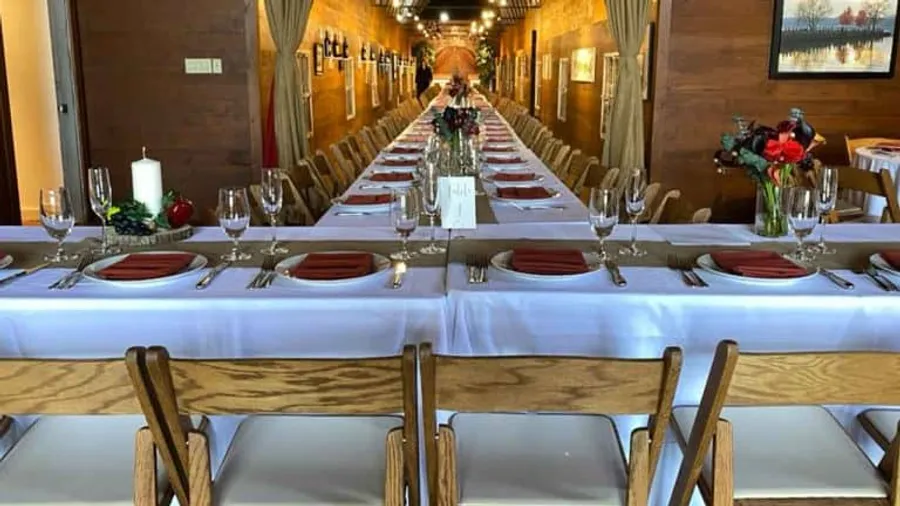
The Hudson Valley’s signature venues are barns, stone buildings, industrial spaces, tents, and historic rooms. They photograph like a dream. They also, acoustically, can be a nightmare if you don’t know what you’re doing.
A converted barn is a big box of hard, reflective wood. Sound bounces around in there. The natural instinct of an inexperienced DJ is to turn it up, which just creates more reflection, more mud, and a dance floor that sounds harsh while the toast is still unintelligible to the back tables. The fix is almost never more volume. It’s placement, zoning, and proper EQ.
This is where my gear obsession actually serves you. I run a digital mixer that lets me EQ the room (DJs call it “ringing out” a space), control different zones independently so cocktail hour in one area and dinner in another each sound right, and adapt to whatever the room throws at me. A stone room, a tented field, a low-ceilinged historic inn, they each need a different approach, and the approach gets decided by someone who’s solved that puzzle before, not someone learning on your dime.
When you tour a venue you love, mention it to any DJ you’re interviewing and listen to how they talk about the space. Real specifics, or at least the right questions, signal a pro. Generic reassurance signals someone who’ll figure it out when they get there.
Demand #3: Coordinating With the Venue and the Other Vendors
Venues have rules, and good ones have a lot of them. Sound ordinances and hard end-times, especially in residential or rural areas. Load-in windows. Restrictions on where you can place equipment, whether you can use certain effects, how amplified the ceremony can be. Some venues require a certificate of insurance from every vendor before you’re even allowed on site, which is standard, and a real business produces one without blinking.
Then there’s the human coordination. On a typical wedding I’m working alongside a photographer, a videographer, a caterer, often a planner or coordinator, and the venue’s own staff. The day runs smoothly when all of those people are quietly in sync, and the DJ is frequently the hub of that coordination because the DJ controls the timeline. When the kitchen needs ten more minutes, when the photographer wants to grab golden-hour shots and the timeline has to flex, when the toast giver wanders off right before their toast, somebody has to absorb that and keep the night flowing. That somebody is usually me.
A wedding DJ who only thinks about music is doing maybe half the job. The other half is logistics and diplomacy, and the venues know it, even if the brochure never says so.
Demand #4: Redundancy, Because the Venue Won’t Save You
At a hotel ballroom you might have some safety net. At a private farm at the end of a dirt road, you are the safety net. The nearest replacement for a failed piece of gear is a closed hardware store a half hour away.
This is why professional DJs carry backups. Backup of the critical components, redundant connections, spare cables, a plan for when something fails because over a long enough career, something eventually will. I approach my whole rig with a modular design specifically so that pieces are interchangeable and a single failure never becomes your problem. You will never hear about most of what could have gone wrong, and that’s the entire point.
The “cheap DJ” math I broke down in my piece on wedding DJ pricing lives here too. A bare-bones operator hasn’t invested in redundancy because redundancy is expensive and invisible right up until the moment it’s the only thing that matters.
Demand #5: Knowing the Room Before the Wedding
The single most underrated advantage in this business is being close enough to actually scout a space. Being based in Kingston, centrally located in the Valley, means I can do a walkthrough of a venue I haven’t worked before instead of showing up cold on your wedding day and hoping.
A DJ coming up from Westchester or down from Albany for a one-off, treating the Hudson Valley as the distant edge of their map, is far less likely to invest that time. Not because they’re bad at the job, but because the logistics make it impractical. Proximity isn’t a small thing. It’s the difference between a DJ who walks in already knowing where the power is, how the room sounds, and where the sun sets, versus one who’s solving all of that for the first time while your guests arrive.
What This Means For You
You don’t need to become a sound engineer to plan your wedding. But you should understand that the venue you choose hands your DJ a specific set of problems, and your job in hiring is to make sure the DJ you pick has solved those problems before.
So when you tour that stunning barn or that off-grid hilltop, ask the DJ candidates the real questions. How do you handle no power. How do you deal with this kind of room acoustically. Have you worked here, and if not, will you scout it. What’s your backup plan if gear fails. Are you insured and will the venue’s requirements be met.
The confident, specific answers come from experience. And experience, in the Hudson Valley, is the whole game.
If you’re planning a wedding anywhere across the Valley or the Catskills and you want a DJ who treats your venue as a puzzle worth solving rather than a surprise to survive, let’s have a conversation.