
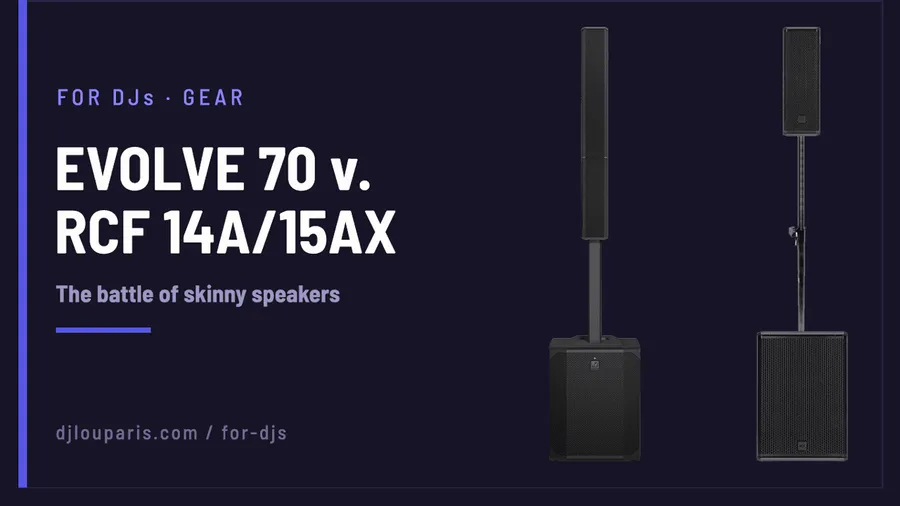
The EV Evolve 70 vs RCF NXL 14A & 15AX
The Next Generation of “Skinny Speakers”
It’s been some years now that the Column Array speaker took the Mobile DJ community by storm. Most focused on a combination of a small footprint, being light to carry, and to deliver big sound to small and medium sized events. As popularity grew so did the desire of the aesthetic of a “skinny speaker” while putting out more and more sound. While some brands like LD Systems had the Maui 44 G1 and subsequently the Maui 44 G2 out for some time, other brands like EV took it’s time to debut their next generation. Meanwhile RCF had a successful sorta-skinny speaker with the NXL 24A, one absolute beast of a top but certainly not compact or weight saving. They saw a market that was not being served and whipped up the NXL 14A as an in-between to the EVOX 12 column array.
Why Compare A Column Array With A Point Source?
Now some people may be wondering why I would even compare a column array setup with a point source setup. They typically serve two different needs with a column array boasting a wide 120º (typically) horizontal throw while a point source generally shoots deeper with a more narrow pattern at 90º. But the NLX 14A does have some unique qualities like a pair of stacked 6″ drivers and 100º coverage. Even some of their literature is marketed towards an “active column speaker” while other literature suggest a point source configuration. Speaking with my very good friend and industry leader Ben Stowe of NLFX Professional we are in agreement this is more-so a point source system, but that the better definition of the market fit is that of “skinny speaker”. DJs are absolutely going to consider this as a similar look that they are going for in their Mobile DJ setups and visually compare better to column arrays vs. the traditional cabinet you’d expect.
The EV Evolve 70
Before we dive into the details I have to give a big shout-out to my good friend Rachel Lynch who has been lucky enough to own a pair of Evolve 70s. Given there are so few models out there to have access to, this was a truly unique first look into the wild of what these speakers offer. And man they did not disappoint.
Impossibly Light
I truly wish we had video rolling when I first picked up the Evolve 70 subs and 70/90 tops out of her car because the look on my face was priceless. They come in at 59 lbs and honestly they felt even lighter than that. The sheer size of it screamed heavy, but it was more than manageable. And the tops come in at a mere 20 lbs. The amount of tech and sound that EV has packed into these form factor is nothing short of astonishing.
Nothings Changed Yet Everything’s Changed
First impressions of sound, specifically compared to the 50, is man did EV nail the tonality of the box. They could have gone different directions on how things sounded, especially with the larger 8x 4.7″ Neodymium drivers, but no. They delivered on the science of the 50 while bumping up specs across the board including more boomy lows and doubling the wattage of the system.
The Technical Specifications
- 133 dB MAX SPL
- 2000W (1000W Bi-Amped)
- 35 Hz – 20 kHz
- 8x 4.7” neodymium drivers
- 15” Sub, 3” vc
- Crossover at ~80Hz
- 120° x 25°
- PowerCON®
- (70 sub size) 24.5 x 17.7 x 23.9
- 78.3 lbs (59.1 lbs sub + 19.2 lbs top)
- $2799
The RCF NXL 14A & 15AX Combination
I was fortunate enough to have heard the RCF 14A and 15AX together in public, for the first time, at The Speaker Shootout at the 2024 Harvest of Sound show. We had grouped it with the Maui 44 G2, the Turbosound ip3000 (which is the guts of the Maui 44 G1, and the Evox 12. Now it is a little bit of an odd class given the price points, however this really became the “battle of the 15-inch column/skinny setup”, and wow did it deliver.
A Sound I Didn’t Expect From RCF
I will absolutely make all my previous biases transparent here, I have never been overly impressed with the sound of RCF. Models like the JMIX8 and the EVOX 12 always seemed to have a muddied middle tonality to it and just didn’t have a lot of musicality out of the box by default. The 14A/15AX combo completely destroyed that notion with a truly rich and warm experience. Of course that is helped with the stacked 6″ woofers and a 1.75″ compression driver to hit those highs.
First Outing, A DJ Friend’s Wedding
Since I don’t have my season starting till May of 2025 I took the opportunity to link up with a my friends David Nazario at a venue I am at a couple times a year that would be a great benchmark of it’s typical use for me. A bit of a bigger room at about 80-100′ deep and 50′ wide it represents the larger side of rooms I generally occupy. And all we could both say is wow. The musicality of the combo is just top rate, the throw is considerable, and filling this room isn’t even a challenge given the combined 4300W peak output of the speakers. We were easily in “3rd gear” all night and they could have given a whole lot more.
Oddities
If there is anything odd to say about the setup is the requirement of the PML60678 stand adapter needed for the box. Most point source boxes has built into the cavity a 35mm input to accept speaker poles. Likely because of design considerations that would interfere with the overall design of the box. So be aware that you do have to account for these adapters in your setup.
The Technical Specifications
RCF 14A Top
- 128 dB max SPL
- 2100W Class-D Bi-Amplification
- 70Hz-20kHz
- 1.75″ Modified Polyether Ether Ketone (PKX) / Neodymium Compression Driver
- 2 x 6″ 2.0” vc High Power Neodymium Woofers Symetrical Config
- Rotatable 100° x 70° TRW Waveguide
- FiRPHASE (DSP)
- Bass Motion Control (BMC) – Stability in low frequencies
- Powercon True1
- 22.32 x 7.76 x 10.63”
- 28.22 lbs
- $1599 ($3798 combined)
Sub 15AX
- 133 dB MAX SPL
- 2200 Watt Class-D Amplifier
- 35HZ-120kHz
- 15” Woofer, bass reflex housing, 3” vc
- Multi-ply hardwood polyurea-coated
- LiveRemote App
- Dual XLR/TRS combo Input + Link, Dual XLR Xover Out
- Bass Motion Control excursion management
- Powercon True1 Top Sealed AC Connector
- M20 Thread
- 23.23 x 16.54 x 23.23”
- 69.23 lbs
- $2199 ($3798 combined)
The “Shootout”
A big thank you first to April Ost of Senate Garage who provided access to not only my favorite venue, but also being only one mile from my home super convenient. And Rachel was able to take a trip up with her EV 70s and see what the venue was all about. This really couldn’t have happened without their help.
We first tested the tonality of the boxes by getting each to 94dBa at 3′ and cycle through a series of different music types. Then we pushed the speakers to the max to see where they would peak out.
And yes there is video of this, but editing is such a chore and there is literally 6+ hours of footage we are still combing through. So as soon as they are added they will be added to the article.
- Setup/Strike Speed: Advantage EV 70. Keeping the comms in the pole and having everything at a lower point to connect and go, the design of the EV column array, be it the 30s, 50s, 70s, or 90s are so damn quick.
- Weight: Advantage EV 70. While the RCF comes in at an impressive sub-100 pounds for the entire rig,
- Music Tonality: Advantage RCF 14A/15AX. Having a dedicated compression driver and stacked 6″ drivers really helps to bring out warmer sounds up higher. This is not to say that the 70 is a slouch by any stretch of the imagination. But the RCF shines a bit more.
- Fatigue Factor: Advantage RCF 14A/15AX. Given the additional wattage capabilities and overall driver sizes up top, you are likely to experience less overall fatigue of the system and on your ears.
- Microphone Tonality: Advantage EV 70. We were all in agreement while the RCF 14A absolutely throws further than the 70s, there is a more pleasant tone coming from the column arrays. This is with a very mild EQ placed on a Sennheiser EW-DX 835 microphone, with low and high pass filters applied and a small dip a little above 1k for general ring-out.
- Subwoofer Presence: Advantage EV 70. It seems impossible with the weight but EV 70 sub hits deep. Both indicate going as low as 35Hz, but the EV just had more umph. Not to say the RCF is not one incredible sub, but you’d have to EQ it more to get closer to that low end.
- Peak Power Consumption. We put a Kill-A-Watt meter in line and measured out the draw of these speakers in a typical performance
- one single Evolve 70s peak @ 230w
- one RCF 14A & 15AX peak @ 391w
One thing we did want to mention is while you can push the RCF 14A & 15AX much further, we gave it a try and inside the room it was simply uncomfortable to listen to. So if you really want to push these really hard they need to be in very very large rooms or outdoor events which these are clearly capable of.
A Surprise Winner As Well… The Evolve 50
We brought my now 8-year-old Evolve 50s to our little shootout to get a baseline of the sound we’d expect and compare to the EV 70s and the RCF 14A & 15AX. We were all in agreement that the 50s absolutely still has it’s place in our setups, and even so much so that a guest DJ (David mentioned above) that arrived to take a listen to the shootout came to the conclusion that the 50s are still one amazing speaker and that he plans to arm his DJ outfit with a number of 50s because of the simple size, weight, and capability of the speaker.
Conclusions Galore
If this shootout proved anything is that we are in a golden age of choices for speakers as mobile DJs. What works for you is going to largely depend on what your desires as a DJ are, the type of crowds, music, rooms, and the like you are faced with, what you can carry reasonably, and so much more. Let’s narrow it down to a few scenarios.
- If you liked the sound of the EV 50s but always were desiring a bit more, the EV 70s (and of course the EV 90s) will absolutely deliver
- If you want the skinny look of a column array but want more throw, the RCF 14A and 15AX combo will be one hell of a setup to compete against
- If you want the most bass performance, the EV70 sub rocks (I can only imagine what the EV 90 sounds like)
- If you still own EV 50s but sometimes find yourself in varied situations like outdoor weddings, or a sub 400 person function the RCF 14A and 15AX combo is a great addition to your arsenal
- If you could only buy one speaker and money, weight, and time are of no object, RCF 14A and 15AX combo stands out
- If you could only but one speaker now and want as much convenience, weight, and sound, the EV 70 sneaks past the rest
Now price is of a big consideration here. The EV 50s clock in at $1799, The EV 70s clock in at $2799, and the RCF 14A and 15AX come in at $3798. So you are talking $1000 price hikes for each jump in class. But you absolutely get a great amount of value of each. So you have to gauge through everything what your final outcomes you want.
My Personal Decision
For me, I’ve decided on keeping my Evolve 50s for smaller events, especially those I have inconvenient load ins on, and adding the RCF 14A and 15AX to my arsenal for good. These are simply incredible speakers with great sound and a lot of overhead to work with. I’ve already sent in my special cable order to Ben Stowe because speed is of the essence for my setups and I always want the cleanest look possible.