
Own Your Library. Don’t Solely Rely On Streaming.
There have always been rumblings that streaming will take over entertainment at events. There are even some apps that focus on automation of music playback. And there is no question that streaming has been dominating the consumer music scene for some time. Gone are the days (mostly) of people digging through vinyl or flipping through CDs.
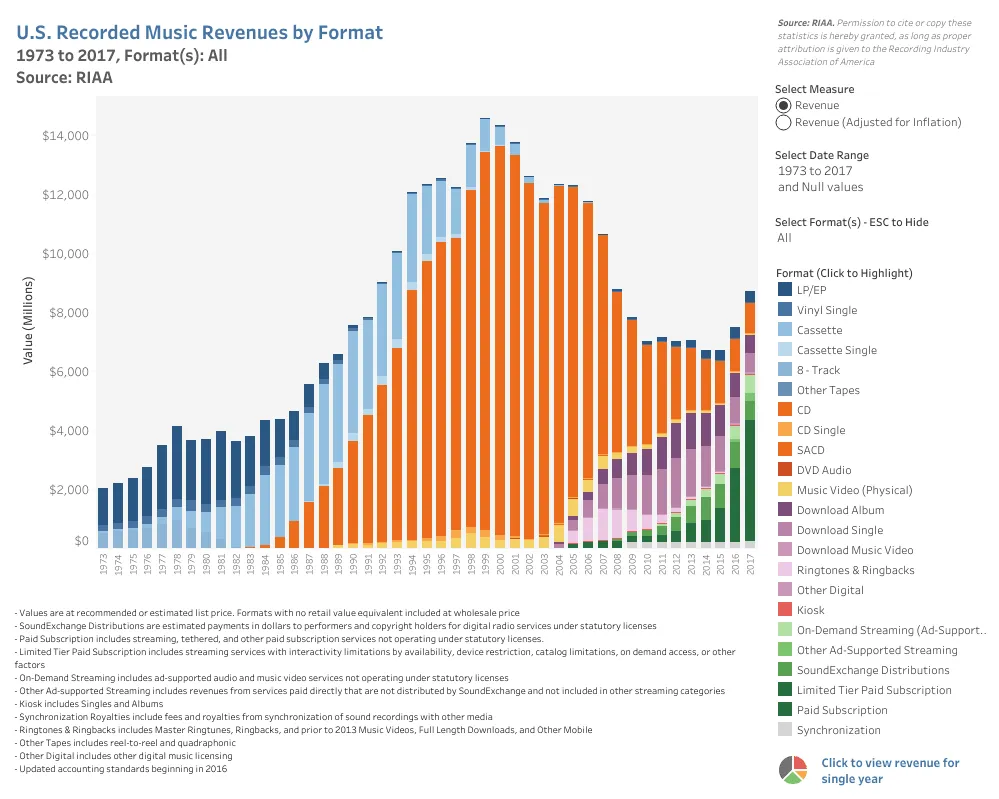
But with that, there is a mentality of using streaming-only services. You usually see this more with newer DJs, but there are certainly some older ones embracing this. There are some benefits, but a bit more bad than good in my opinion. Let’s dive into this a bit more.
Licensing limitations
By far, one of the more limiting things on streaming is it’s licensing. As of the writing of this article services like Spotify do not allow licensing for public or commercial performances in the US. Other services like Tidal and Soundcloud who are integrated into some DJ applications do not have a lot of languages associated with public performance playback. However just because it exists in the platform does not necessarily make it legal.
This is where the ambiguity of copyright law rears its ugly head. I’ve written extensively on the subject and honestly when push comes to shove, and if the labels decided they don’t like the terms of an agreement, they could muscle their way to yank their catalog off the service.
And we are seeing GIANTS in the streaming world like Spotify who are being sued in 2024 for not paying their proper share of things.
Lack of ownership
Like it or not, when you stream you are at the complete mercy of those companies. So if and when they have an issue with a licensing deal with a label or artist you could find yourself without many of the songs you had the day before. Or that company can go completely under, and so goes at least a portion of your music.
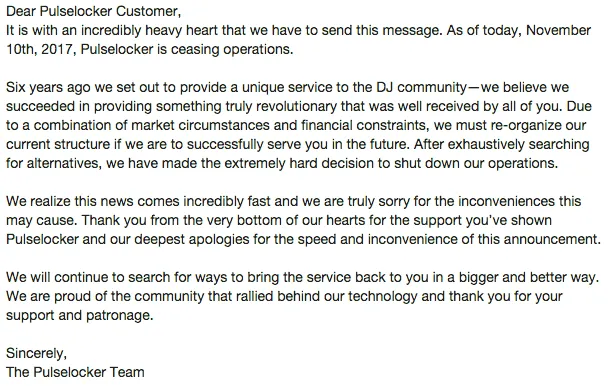
Heck in September 2017 Spotify nixed their integration into Virtual DJ. And then in November of 2017 Pulselocker announced it was shutting down.
And it is not limited to just one platform. Tidal had a major outage in mid-2024, and then on New Year’s Eve heading into 2025, both KaraFun and Tidal went down within the same window. I watched it unfold in real time. On the single biggest party night of the year, DJs were scrambling and panicking across Reddit and Facebook because the source they leaned on had simply vanished mid-event. No matter the size, any streaming service is subject to server conditions, licensing agreements, and more.
This may not be a big deal for the casual listener, but for a professional DJ this could mean disaster. That is something you need to seriously consider, especially for some of the DJs who are starting to build up their library solely on streaming media services.
Broadband is not widespread
Yes, broadband seems to be everywhere. Cell service is in most places, and many venues have wifi. However, many communities have access to fairly slow internet services, and some still have none at all. Further, many venues do not have access to fast internet, and with the large crowds that gather at these venues the ability to get fast access can be nil.
Reliability can never be 100%
Imagine it is your first dance as a married couple. Your song starts, everyone is focused on you and a milestone in time that can never be duplicated, and all of a sudden…
Even with the fastest internet speeds, you can run into bottlenecks, and sometimes that service can just be down. Sure, some applications let you download songs temporarily, but it still can be pulled at a moment’s notice. Working in backup scenarios with these kinds of services is also pretty much non-existent.
And while yes, some services do allow you to download a local file, that isn’t always guaranteed to play back. These services have to “phone home” consistently to check on your license, and if their servers are down, so is your ability to play tracks. It does not matter if you have hundreds or even a couple thousand songs saved locally. If the software cannot reach home to validate your license at that moment, you are not playing anything.
Streaming service catalogs can be inferior
While streaming services like Spotify boast huge libraries of music, they can still be woefully incomplete, especially with older music. For example, a simple list of some of the top hip-hop songs that I created has almost 33% of the music unavailable in their library. For many professional DJs, they will go to extraordinary lengths to ensure that their music catalogs are very broad, covering from as early as the 1920s to today’s hits. Many labels refuse to offer their music to streaming services, and sometimes even services like iTunes. A professional DJ will get that music on whatever medium it is available.
Anti-streaming is not anti-technology
I am not a technophobe. I have a nearly multi-decade long career in IT, and I am always on top of the newest trends and technologies. I embraced the change in DJ technologies, going from vinyl to CD to digital media. However, one needs to be mindful of the capabilities of what a particular technology has to offer, and what its shortcomings are. My personal opinion is that streaming music is an awesome service for personal use. For professional services like DJing, where music is critical, it is a service that can never compare to a DJ with a catalog of music in hand, not in the cloud.
Computer Resources
One thing some people don’t realize is that running additional services on a computer, like wifi, can degrade the performance of the machine, especially in things like audio clipping. Naturally a more “beefy” computer can handle it, but if you are running thin on resources this could be an additional burden you don’t want to place on your machine in the heat of an event.
Outright Arrogance
I see this pop up from time to time, typically younger DJs who have been so engrossed in the streaming world that they feel not paying for their source material is somehow a badge of honor.
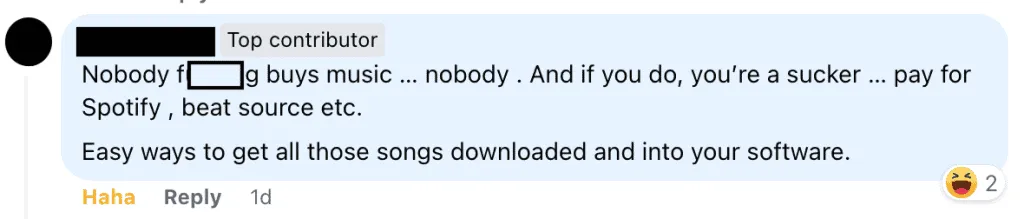
This is certainly not the behavior that a true professional should exhibit. This almost sense of entitlement, that a DJ will just pull from streaming sites as their only source of music. As the past has shown, this is a foolhardy take on music acquisition.
What should you do?
Now one of the best steps a DJ can take is to subscribe to a music pool, in which you pay a single monthly or yearly fee to get access to a treasure trove of typically newer music. But not all music pools are created equal. Some are set up in legally murky countries and sometimes put up music that is not on the up and up. So check out the truly legit pools like Promo Only.
For older music you should look towards compilation albums, since obtaining legit, legal older music from pools is pretty rare. If you do see a large pool of older music on a pool, chances are they are skirting the edge of the legal distribution of that music.
This is exactly where physical media still earns its place. Greatest hits collections, soundtracks, and the old Time Life sets pack a dense, dirt-cheap amount of catalog into a single purchase. Grab an external USB CD ripper (I paid about 15 dollars for mine and it is shockingly fast) and you can churn through a stack of discs in an afternoon. I still hunt down big lots of CDs on eBay and buy them outright. That is part of the business, and part of cultivating your sound and who you are as a DJ. Once it is ripped and sitting in your library, it is yours. No copyright holder can yank it the day they fall out with a streaming service.
A larger discussion. Know and own your music.
I started DJing in 1988, where there were no MP3s. Heck, CDs were not even big in the industry yet. As a DJ you were hired not only because of your skills, but also your music curation. Now, with huge libraries that fit into the palm of your hand and the demand from people that you literally have any song on the planet, it is time to take a step back. It is time to get back into curation, knowing what you are buying, storing, and ultimately playing.
In practice, this is why I deep dive with every client well before their event, so I know I am walking in with the right material in hand rather than hoping a server cooperates. And if a guest walks up and asks for something genuinely obscure that I do not have, then I simply do not have it. That is a far better spot to be in than having the song exist somewhere in a cloud I cannot reach while the dance floor is waiting.
Have enough of a library to hit any genre that comes at you, but do you really need 27 versions of one song? Know your music. Invest in the tools that make you a professional. The most critical piece of this is the songs you play.
This article was originally written on February 23, 2014 and was updated on November 10, 2017, including changing the title from “Your A DJ. Own Your Music.” Additional changes were applied on February 18, 2019 and December 31, 2024, including adding video, removing some pool services that no longer exist, and expanding on the topic of licensing and outage issues. A further update in 2026 folded in points from the companion video, including the New Year’s Eve 2024 outages that hit both KaraFun and Tidal, the 2024 standoff between TikTok and Universal Music Group, and a few hands-on notes on building out an older-music library.